Why the Sun is likely to escape Ipso censure over its jihadi poll
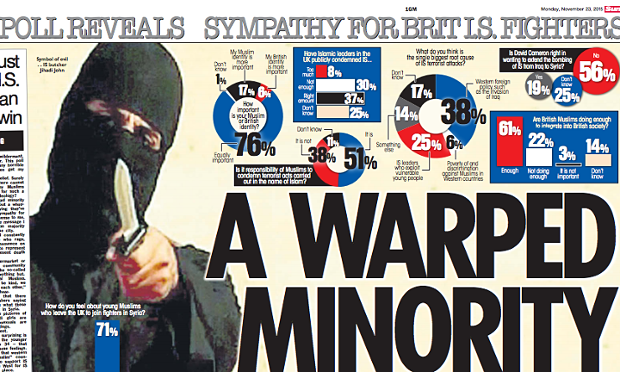
Despite of a major backlash through social media, particularly Twitter users. The national tabloid The Sun is arguably evading the Ipso censure due to its corporate power under the protection of the Murdoch empire. This highlights an argument about the empowerment of audiences being futile in comparison to the invincible nature of major institutions.
He's a terrorist, but so are these guys
The news headline by Daily News of New York City provides a commendable article on the recent West American shootings by a jihadi couple from California. The news article places the jihadi among many terrorists of a Caucasian background, and by doing so, eliminates the prejudice targeted specifically to ethnic minorities of America - this counter-narrative to the Islamophobic nature of most news corporations was commended by media personality Piers Morgan.
Monday, 7 December 2015
Weekly New/Digital Media Homework 11
BBC3 TV channel to be switched off by February, BBC Trust confirms
NDM case study: News on the Tweet

News on the Tweet is a report from Newsworks (a marketing organisation representing newspapers) and Twitter designed to show the positive impact new and digital media can have on traditional media.
_________________________________________
Why are respected news brands good news for Twitter?
Among the abundance of sources, users need to be provided with credible news providers from which they can trust to receive accurate and legitimate information
Why in turn is Twitter good for respected news brands?
Twitter provides a platform/medium through which respected news brands can have their works publicised and made accessible for a myriad of followings to consume and share/discuss the news.
The report suggests that old and new media “are not, in fact, in direct competition, but often work extremely well together to enhance both the media eco-system and the consumer experience”. What evidence do they provide to support this idea? Do you agree with it?
Arguably this view is justified by Twitter activity inn action as statistics suggest that 60% of newsbrand Twitter followers claim to have never usually read newspaper brands in print format prior to following them on Twitter. This is agreeable as we witness many young people subverting the stereotypical expectation for them to be dull and not opinionated on news stories - clearly a thwarted view as a result of Twitter discussions relating to links to news articles.
On page 24/25 of the report, the focus turns to 'gossip' or 'banter'. What example tweets from journalists are used to illustrate this?
- "Grace Dent @gracedent • Nov 6
I reveal the shocking truth behind Jennifer
Aniston’s new hair http://ind.pn/HJXtV9" - Illustrates this view of gossip - justified by a display of personality and interest of the Tweeter.
- "Camilla Long @camillalong • Feb 16
Favourite story all weekend has been Del Boy
killing the British sheepskin coat industry. LOL" - 'Bit of banter' - Reflects personality with light-hearted humour
Do you think the increasing amount of 'gossip' or 'banter' is harming the reputation of news and journalists?
I believe this opinion to be reductionist in the sense that it disregards the autonomy for the audience to be able to choose what news they read. Among a majority of serious news stories, there are segments dedicated to a type of news which may not be respected - celeb gossip. football scandals etc.
What does the report say about trust in Twitter and journalists (look at pages 34-39)?
The report illustrates the symbiotic relationship between Twitter and journalists with the expression of 'a virtuous circle' - Twitter provides journalists with a platform to connect with audiences on a personal level, creating the resultant view of them as honest and expert.
Finally, do you think new and digital media developments such as Twitter have had a positive or negative impact on traditional newspapers?
I believe that new and digital media developments such as Twitter have placed an unprecedented importance on news today across all audiences due to the convergence and relevance of technology in modern lifestyles. The resultant effect may be negative on traditional newspapers in print form, however, adapting companies can still profit if they use tactics from online based journalists such as TheHuffingtonPost or BuzzFeed who rely on consumer created content and citizen journalism while still providing a level of curation to check legitimacy and for censorship before publicising material to audiences.
Saturday, 5 December 2015
Globalisation and the media: wider issues
1) Why was Google Glass controversial?
Physical social interaction was a techno-panic highlighted as humans may become "less engaged" in conversations with each other as others become occupied with accessing the internet. Privacy issues were also raised in accordance to non-consented filming, location tracking and sound recording - all data which is supposedly accessible to 'Google agent' - a techno-panic highlighting the convergence Google encourages in all of their products being increasingly associated to people's personal lives and thus suggesting datamining as a privacy concern.
2) What are the positive elements to Globalisation that the article highlights?
Enrichment through increased choice of material and opportunities.
Access to information enhances democratic process.
Enables informed decisions on anything.
3) What are potential negatives to Globalisation?
Smaller organisations remain small while the minority possesses the majority of worldly wealth among themselves as a monopoly.
4) What is a techno-panic? How does it link to moral panics?
The idea of a moral panic is reinvented to adapt the development of technology as a potential threat which may concern society and trigger such concerns in the media in an elaborate way to be thus reinforced by the public.
5) What is your opinion on the privacy debate and major corporations being able to access large quantities of personal data?
My personal opinion is formed on the basis that major corporations simply cannot consistently track a mass audience of people, and it would be futile regardless. There aren't any legitimate repercussions which arise from the access of personal data belonging to Glass users, and one of the cautionary tips warranted by the use of such equipment is indubitably that users should (as ever) be weary of what is seen through the lenses. To a further extent, access to personal data could be useful in retrospect to solving crimes, and thus beneficial without much harm to privacy - safety first!
Physical social interaction was a techno-panic highlighted as humans may become "less engaged" in conversations with each other as others become occupied with accessing the internet. Privacy issues were also raised in accordance to non-consented filming, location tracking and sound recording - all data which is supposedly accessible to 'Google agent' - a techno-panic highlighting the convergence Google encourages in all of their products being increasingly associated to people's personal lives and thus suggesting datamining as a privacy concern.
2) What are the positive elements to Globalisation that the article highlights?
Enrichment through increased choice of material and opportunities.
Access to information enhances democratic process.
Enables informed decisions on anything.
3) What are potential negatives to Globalisation?
Smaller organisations remain small while the minority possesses the majority of worldly wealth among themselves as a monopoly.
4) What is a techno-panic? How does it link to moral panics?
The idea of a moral panic is reinvented to adapt the development of technology as a potential threat which may concern society and trigger such concerns in the media in an elaborate way to be thus reinforced by the public.
5) What is your opinion on the privacy debate and major corporations being able to access large quantities of personal data?
My personal opinion is formed on the basis that major corporations simply cannot consistently track a mass audience of people, and it would be futile regardless. There aren't any legitimate repercussions which arise from the access of personal data belonging to Glass users, and one of the cautionary tips warranted by the use of such equipment is indubitably that users should (as ever) be weary of what is seen through the lenses. To a further extent, access to personal data could be useful in retrospect to solving crimes, and thus beneficial without much harm to privacy - safety first!
Monday, 30 November 2015
Weekly New/Digital Media Homework 10
Why the Paris attacks got larger UK coverage than other tragedies
This opinionated article by Greenslade argues the viewpoint that audiences are more interested in terror attacks closer to home - a perspective resembling that of media critic Alain de Botton, who advocated the importance of empathy when consuming news.
The legendary BBC Red Button has faced the 'axe', with the prevalence of new and digital media. The medium is now seen redundant due to the availability of news reports and sports updates via the internet.
Weekly New/Digital Media Homework 9
#1in5Muslims: Twitter mocks Sun front page with 'facts' about Muslims As ever, Twitter users strike once again to criticise a xenophobic headline by TheSun after a recent moral panic about the threat of jihadis. This reflects the empowerment audiences have via the use of social media in order to backlash against major corporations.
Mali hostage films from hotel window - video http://trib.al/mN2BscE
A Chinese tourist kept hostage utilises his smartphone to provide footage of crime in Mali. This exemplifies citizen journalism with importance as TheGuardian accesses the material to use for a news story based on the occurrences in Mali.
Saturday, 28 November 2015
NDM News: Globalisation
1) Is our news influenced by American cultural imperialism? What examples can you think of?
Although contrarily arguable, I believe that the news of Britons is much profoundly influenced by domestic British organisations rather than American conglomerates. News services by FOX for example, are mocked by British critics and most media intellectuals due to the sheer ignorance and bias promoted by the corporation. Judging by the perspective of a Londoner, accustomed to ethnic diversity, the BBC provides a much culturally diverse news provision rather than traditional institutions such as the DailyMail or The Sun - ran by Murdoch.
2) Has the increased globalisation of news improved the audience experience? How? Why?
It can be suggested that the globalisation of news has improved audience experiences as awareness and familiarisation is developed. This is informative as well as educational for audiences as they aren't ignorant to the wide range of social climates occurring worldwide.
3) Has globalisation benefited or damaged major news institutions? How? Why?
Globalisation can be said to benefit major news institutions because they can now have increased power over foreign countries and manipulate their views and ideas - culture. However, damage can be incurred to such news insitutions as residents become familiarised to more personal and reliable accounts by people over social media - citizen journalism.
Although contrarily arguable, I believe that the news of Britons is much profoundly influenced by domestic British organisations rather than American conglomerates. News services by FOX for example, are mocked by British critics and most media intellectuals due to the sheer ignorance and bias promoted by the corporation. Judging by the perspective of a Londoner, accustomed to ethnic diversity, the BBC provides a much culturally diverse news provision rather than traditional institutions such as the DailyMail or The Sun - ran by Murdoch.
2) Has the increased globalisation of news improved the audience experience? How? Why?
It can be suggested that the globalisation of news has improved audience experiences as awareness and familiarisation is developed. This is informative as well as educational for audiences as they aren't ignorant to the wide range of social climates occurring worldwide.
3) Has globalisation benefited or damaged major news institutions? How? Why?
Globalisation can be said to benefit major news institutions because they can now have increased power over foreign countries and manipulate their views and ideas - culture. However, damage can be incurred to such news insitutions as residents become familiarised to more personal and reliable accounts by people over social media - citizen journalism.
Subscribe to:
Posts (Atom)